![[Z-series]](../../img/03_Z-series_min.png)
“Four Guardians” Ranma Plates
Bronze casting / 2025

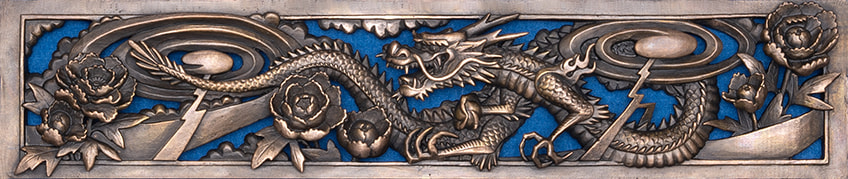

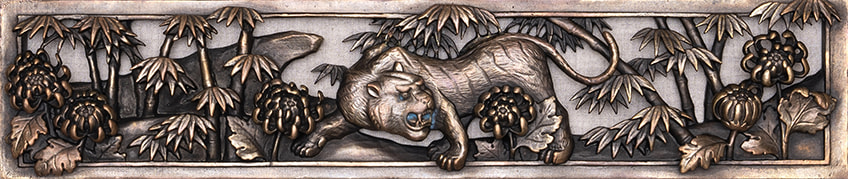
This work uses the symbolism of the Four Guardians—mythic protectors of the north, south, east, and west—to weave together people and space, tradition and the present, the individual and the whole.
The “Four Guardians” (shijin) are a set of sacred beasts from ancient Chinese astronomical thought and the yin–yang/five-elements system, and guard the north, south, east, and west. Each creature governs a direction, season, color, and role, forming a balanced model of the cosmos. Across East Asia, including Japan, they are not treated as mere animals of fantasy but as a symbolic framework for cosmic order—shaping city planning, tomb alignments, and the spiritual culture of the people.
This work, Four Guardians Ranma Plates, is a set of four plates newly sculpted in bronze, drawing inspiration from the aesthetic of openwork carving found in traditional Japanese architectural transom panels called ranma . Ranma have long served to let light and air into the interior while adding division and beauty to the space. The piece inherits that craft lineage and reinterprets it in a durable medium: metal.
Each plate depicts one guardian, carrying its own meaning and protective force. However, when all four plates are assembled, their meaning expands significantly. By placing four plates at each of the four directions, the enclosed space manifests a power as a “protected boundary” (or “kekkai” in Japanese), much like ancient peoples did in designing cities and arranging tombs. The ancient logic of warding off harm and inviting prosperity is transcribed and reproduced as a contemporary art installation. The structure—shuttling between the individual and the whole to generate layered significance—embodies the Four Guardians’ worldview.
The tension between a single plate’s symbolism and the harmony that appears only when all four unite—that duality is at the heart of the Four Guardians Ranma Plates.
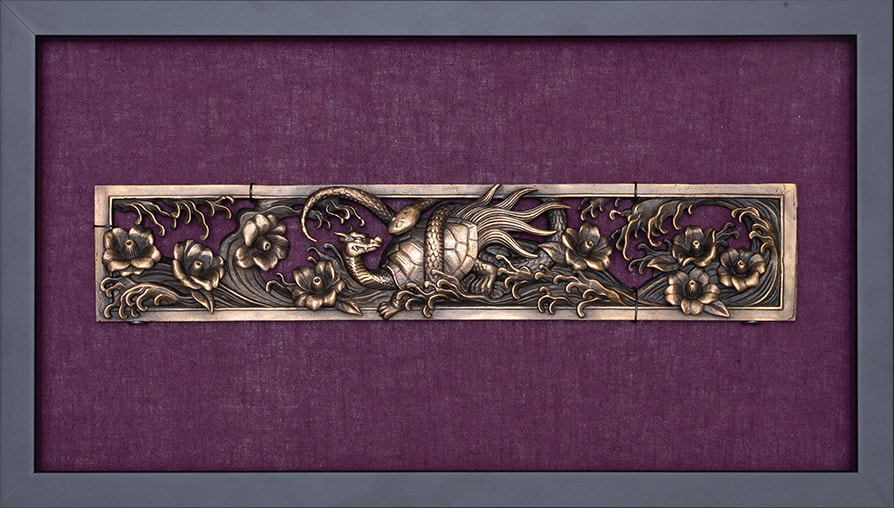
“Genbu” Ranma Plate (North/Winter)
W:467mm × D:266mm × H:40mm / Bronze casting / Framed / 2025
$2,333.34(1$=150JPY)
(※The price excludes taxes, duties, and shipping.)
Genbu is one of the Four Guardians from ancient Chinese cosmology and the yin–yang/five-elements system. It rules the north and the season of winter.
Genbu appears as a tortoise entwined with a serpent. The tortoise signals immortality and long life; and the snake evokes renewal and cyclical time. Joined together, they embody yin–yang balance and have been thought to harbor the power of eternal youth and life.
This symbolism was reflected in urban design. In China, ideally, a city would have a protective mountain to the north to block cold winds—a concept carried into Japan. In Heian-kyo (founded 794; present-day Kyoto), Mount Funaoka to the north was identified with Genbu and treated as a guardian of the capital. Also in Korea’s former capital, Hanyang (present-day Seoul), Mount Bugak played a similar role to Genbu.
Genbu pacifies the harshness of winter and the northern quarter as an entity that brings the stability of the heavens, centered on the North Star, to earthly cities. As such, Genbu has been deeply intertwined with people's perceptions of cities and their worldviews.

This work is offered in a limited edition of 300, created exclusively to order.
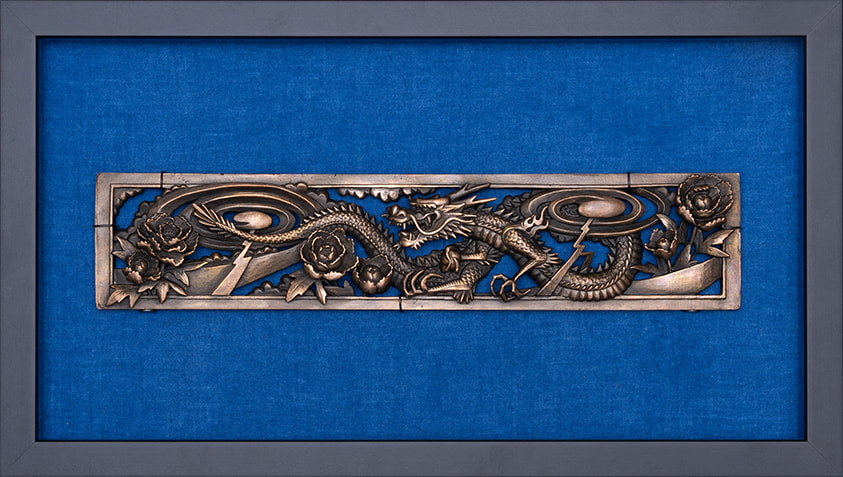
“Seiryu” Ranma Plate (East/Spring)
W:439mm × D:250mm × H:40mm / Bronze casting / Framed / 2025
$2,333.34(1$=150JPY)
(※The price excludes taxes, duties, and shipping.)
Seiryu (the blue dragon) is one of the Four Guardians from ancient Chinese cosmology and the yin–yang/five-elements system. It is the guardian of the east and the season of spring.
Depicted as a dragon dancing in the sky as it summons clouds, rain, and thunder, in rice-growing East Asia, Seiryu became a revered bringer of fertility as it governs the rain and rivers. The two qualities of “water” and “sky” embodied by Seiryu symbolize the connection between earthly agriculture and celestial weather. It is considered to represent the budding (growth) of life in spring, the beginning and cycle of the seasons, and prosperity.
This symbolism has been reflected in urban design. An ideal capital was expected to “receive” Seiryu with a major river to the east, aligning the city with natural cycles. In Heian-kyo (Kyoto), established in 794, the Kamo River to the east was identified as Seiryu, a symbol of protection and prosperity. Similar pairings of cities with rivers or lakes appear in historical capitals in China and Korea. By connecting the city to rivers and lakes, they sought to harness the power of Seiryu.
More than a myth, Seiryu is deeply embedded in East Asia’s culture, city ideals, and arts—and its symbolic force endures to this day.
This work is offered in a limited edition of 300, created exclusively to order.
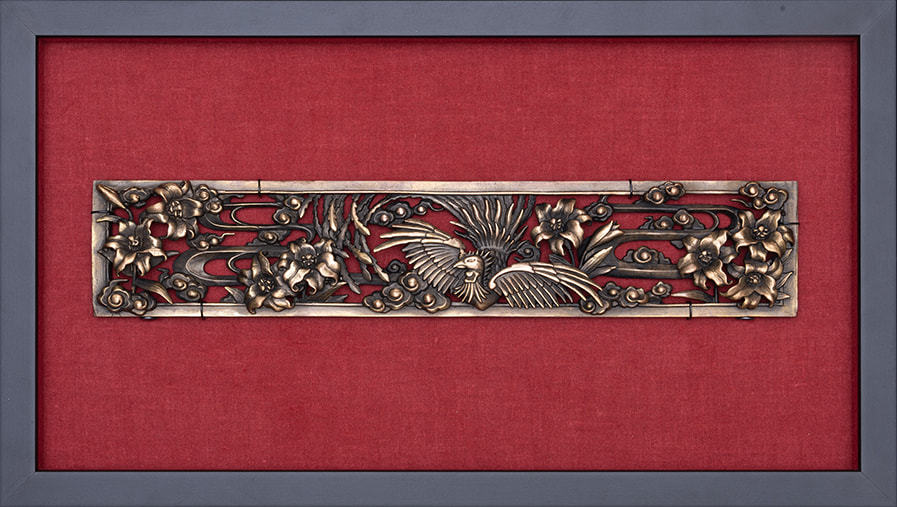
“Suzaku” Ranma Plate (South/Summer)
W:467mm × D:266mm × H:40mm / Bronze casting / Framed / 2025
$2,333.34(1$=150JPY)
(※The price excludes taxes, duties, and shipping.)
Suzaku (the vermilion bird) is one of the Four Guardians from ancient Chinese cosmology and the yin–yang/five-elements system. It guards the south and presides over summer.
Suzaku is portrayed as a radiant bird with flaring vermilion wings, reminiscent of the sun’s blaze—an emblem of vitality, joy, and good omens.
Suzaku has been believed to bring happiness and prosperity by descending by southern waters and sweeping away misfortune and evil spirits with its wings. Hence, capitals in China and Japan ideally placed a pond or lake to the south to “receive” Suzaku. In Heian-kyo (currently Kyoto), founded in 794, the southern Oguraike pond was identified with Suzaku and treated as a talisman for the city’s peace and prosperity.
The scene of sunlight glinting on the water’s surface was likened to Suzaku in flight. Dancing with auspicious clouds and flames, Suzaku channels the power of the sun down to earth as a provider of light and life—an image that still lives in East Asia’s spiritual culture.
This work is offered in a limited edition of 300, created exclusively to order.
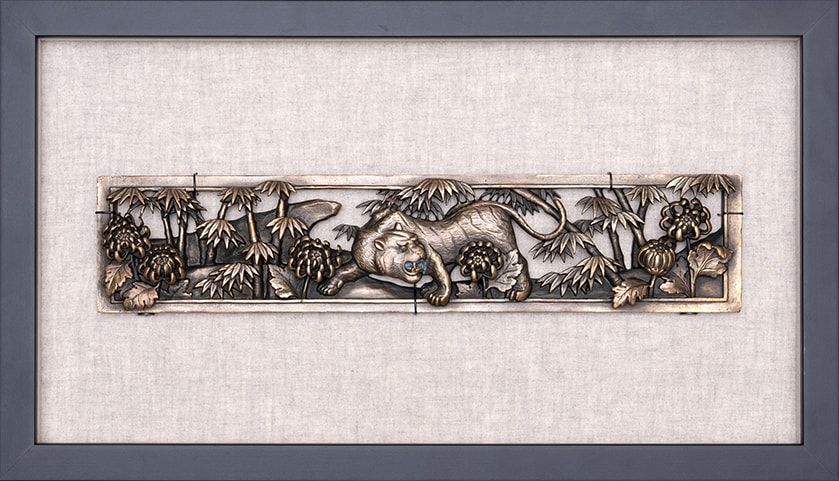
“Byakko” Ranma Plate (West/Autumn)
W:439mm × D:250mm × H:40mm / Bronze casting / Framed / 2025
$2,333.34(1$=150JPY)
(※The price excludes taxes, duties, and shipping.)
Byakko (the white tiger) is one of the Four Guardians from ancient Chinese cosmology and the yin–yang/five-elements system. It protects the west and presides over the harvest season of autumn.
Byakko is depicted as a great tiger with gleaming white fur. Its white color represents purity and austerity, while its tiger form denotes courage and strength—hence it is associated with justice and power.
In urban planning and feng shui philosophy, Byakko plays a crucial role. An ideal capital “receives” Byakko with a broad westward road—an idea adopted in Japan. In Heian-kyo (currently Kyoto), founded in 794, the west-running Nishioji Avenue represented Byakko, a symbol of autumnal harvest and the stability of the capital, while also warding off misfortune from the west. Thus, the city itself was aligned with natural order, with Byakko mirroring heavenly law on earth.
Across East Asia, the tiger has long combined ferocity with sacred presence, and Byakko is thought to be the ultimate expression of that ideal. As an emblem of banishing malevolent forces and upholding justice and as the “final guardian” of order, it still inhabits the cultural imagination.
This work is offered in a limited edition of 300, created exclusively to order.
“Four Guardians” Ranma Plates – Set of Four Seasons
(East, West, South, and North)
Genbu, Suzaku:W:439mm × D:250mm × H:40mm
Seiryu, Byakko:W:467mm × D:266mm × H:40mm
Bronze casting / Framed / 2025
The 4-plate set $8,000.00(1$=150JPY)
(※The price excludes taxes, duties, and shipping.)